Knight's Ferry - 1863


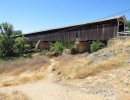


The 1863 Knight's Ferry Bridge is a historic covered bridge spanning the Stanislaus River at Knights Ferry, in Stanislaus County, California. Almost 379 feet (116 m), this bridge is one of the best-preserved 19th-century wood-iron Howe truss bridges to survive.
Standing at the eastern edge of the small community of Knights Ferry, the bridge spans the Stanislaus River a short distance upriver from the modern Sonora Road bridge. The bridge has a total of four spans set on stone abutments and piers. In addition to spanning the river, the bridge crosses a historic millrace north of the river. The bridge sections consist of Howe trusses formed out of wooden planks bolted together, with wrought iron tension rods, all joined by wrought iron bearing blocks. The exterior of the bridge is finished in vertical board siding, with a metal roof.
Knight’s Ferry was first settled by Dr. William Ferry in the spring of 1849. Besides being a doctor, he was also a prominent fur trader. Knight partnered with James Vantine and created a ferry to cross the river. Located conveniently between the port of Stockton and the Sierra foothills, which were at the time rich in gold, Knights Ferry became a hot spot to cross the river, and during the gold rush saw profits as high as 500 dollars per day. Unfortunately, Dr. Knight did not yield great profits as he was murdered in the middle of town in late 1849.
From heavy winter and early spring rain, flood waters raged through Knights Ferry at levels that were close to 35 feet above present-day low water marks. Fortunately, the bridge was built sturdily, and the water could not take it down. Unfortunately, the bridge upriver at Two-Mile Bar was not built as sturdily and eventually washed down and destroyed the old Knights Ferry Bridge.
Consequently, this bridge is the second to stand on the site, built in 1862–63, after the first bridge (built in 1856) was swept away during the Great Flood of 1862. Because of this flood, the new bridge was built on higher piers. For a long time, the bridge was known as the longest covered bridge west of the Mississippi River, and since the 2011 destruction of Old Blenheim Bridge in New York State, which had approximately the same length, it is the second-longest covered bridge in the United States, behind the Smolen-Gulf covered bridge in Ohio.
It was designated a U.S. National Historic Landmark in 2012 and was documented by the Historic American Buildings Survey and by the Historic American Engineering Record. In addition to its status as a National Historic Landmark, it is also listed on the National Register of Historic Places as a contributing structure in the Knights Ferry historic district.
Located at: N37 49.185 W120 39.834 - WGCB #05-50-01
Photographed in May of 2025
Photos by Millard Farmer